

Contact centres are the beating heart of many industries, from emergency services to banking, telecommunications, and community support. Yet behind the constant flow of calls sits a workforce facing some of the toughest health and wellbeing challenges of any desk‑based occupation. Long hours of sitting, high workloads, emotional strain, and tightly monitored schedules all shape the daily reality of contact centre work.
A new systematic review led by BeUpstanding team member Dr Charlotte Brakenridge and colleagues brings together findings from 54 studies and 24 grey literature reports to understand what helps – and what hinders – health promotion in this unique environment. Their review offers insights how workplaces can better support contact centre workers to sit less, move more, and protect their mental and physical wellbeing.
Background: A global industry with local health impacts
Contact centres represent one of the world’s largest service industries, employing millions of workers across the globe. In the United States alone, the sector employs an estimated 2.86 million people, while 29,000 Australians are employed in the industry. Contact centre workers experience high levels of stress, monitoring, low job control, and repetitive, sedentary tasks, all of which contribute to musculoskeletal issues, mental health concerns, and high turnover. The structure of contact centre work has also been linked to burnout, emotional strain, and reduced wellbeing.
Against this backdrop, health promotion becomes essential. Yet implementing it in contact centres is uniquely challenging. We saw this play out in our BeUpstanding implementation trial. Contact centres were one of our priority groups for enrolment, but despite targeted recruitment efforts, they were the most difficult to get on board and retain in the study.
The challenge: high demands, low control, and a culture of sitting.
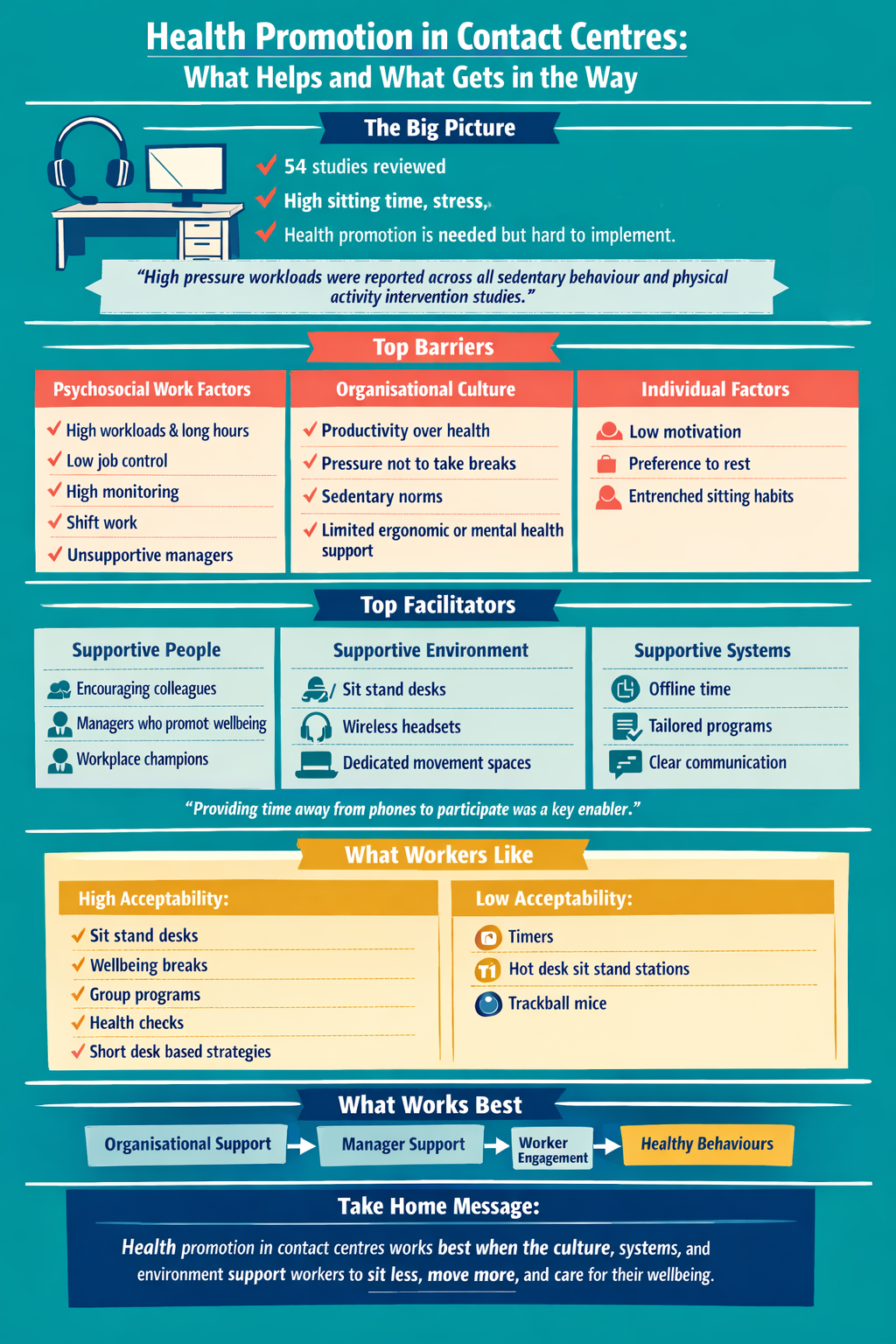
Across the studies included in the review, one message was unmistakable: psychosocial work characteristics are the biggest barrier to health and wellbeing in contact centres. Workers reported:
- High pressure workloads and long hours across all sedentary behaviour and physical activity intervention studies.
- Low job control and tightly monitored breaks where workers had little time to take exercise breaks, and there was a high level of monitoring of performance and behaviour.
- A culture that prioritises productivity over health with workers reporting pressure to not take breaks or sick leave, and a culture of sedentary behaviour.
- Limited access to supportive equipment such as sit‑stand desks or quiet spaces for recovery.
These conditions make it difficult for workers to engage in even brief movement breaks, let alone structured wellbeing programs.

What Helps? Support, flexibility, and the right tools
Despite the challenges, the review highlights clear facilitators that consistently support healthier behaviours:
- Supportive colleagues and managers: Workers valued encouragement from peers and leaders, especially when managers actively promoted or participated in wellbeing activities.
- Offline time to participate: Providing protected time away from phones was a powerful enabler.
- Physical supports: Sit‑stand desks, wireless headsets, and dedicated spaces for movement or relaxation made a meaningful difference.
- Tailored, well‑communicated programs: Interventions worked best when they were designed with workers, fit the realities of the job, and were promoted clearly and consistently.
- Organisational buy‑in: When senior leaders recognised the business benefits of wellbeing, including retention, morale, and performance, programs gained traction.
What Workers Found Acceptable
The review also explored what workers actually liked and were willing to use. High‑acceptability strategies included:
- Sit‑stand desks
- Health checks and feedback
- Education and training sessions
- Group‑based programs
- Wellbeing breaks
- Wireless headsets
- Onsite counselling
- Short, desk‑based movement strategies
Less acceptable strategies included timers (too disruptive), hot‑desk sit‑stand stations (too inconvenient), and some ergonomic devices like trackball mice.

A system that shapes behaviour
One of the key insights from the review is how interconnected the barriers and facilitators are. Organisational culture influences job demands, which influence individual motivation, which in turn affects engagement with health promotion. In supportive cultures, these relationships become mutually reinforcing, creating a healthier, more sustainable work environment. It is why at its heart, BeUpstanding is about changing the culture of the workplace to create a more supportive environment for movement.
What these findings mean for contact centres
The review concluded that health promotion in contact centres is possible, but only when work design and culture support it. For workplaces looking to make meaningful change, the review points to several practical steps:
- Build wellbeing into the rhythm of the workday
- Provide protected offline time
- Invest in supportive equipment
- Train and empower managers
- Co‑design programs with workers
- Communicate clearly and often
- Celebrate small wins
- Shift the culture from “always on” to “health is part of how we work”
These changes support retention, performance, and organisational resilience and a healthier, happier workforce.
Why this matters for BeUpstanding
The findings reinforce what BeUpstanding has long championed: reducing sitting and supporting movement at work requires a whole‑of‑workplace approach. For contact centres, where sitting is deeply embedded in the job, this means designing strategies that are flexible, feasible, and grounded in the realities of the work – something that the participative approach used in BeUpstanding is designed for. With the right supports in place, contact centre workers can thrive and workplaces can reap the benefits of a healthier, more engaged workforce.
Read the full article: Barriers, facilitators and acceptability of health promotion initiatives and behaviours in contact centre workers: A systematic review


Comments are closed.