

Public servants, including administrative officers, clerks, healthcare coordinators, and educators, often spend much of their workday seated. Whether in front of computer screens or attending meetings, prolonged sitting is common. For example, the Stormont Study, which involved 4,436 Northern Ireland Civil Service office workers, found they averaged 6.3 hours of sitting per workday, accounting for a large proportion of their occupational time.
Prolonged sedentary behaviour like this significantly increases the risk of musculoskeletal disorders (MSDs), particularly affecting the neck, shoulders, and lower back. In Malaysia, a study of 417 public-sector office workers found that 92.8% reported MSD symptoms over a six-month period, with physical workload, psychosocial stress, and prolonged sitting as key predictors of pain.

Why It Matters
Musculoskeletal disorders extend beyond physical discomfort. They interfere with job performance, reduce mental wellbeing, and increase fatigue. Employees experiencing MSDs are more likely to suffer psychological distress and report reduced occupational functioning due to persistent pain and concentration difficulties.
Sedentary behaviours, such as sitting for long periods without breaks, have consistently been identified as a major risk factor for developing MSDs, especially in desk-based roles like those in public service. These conditions contribute to higher absenteeism and presenteeism, leading to significant productivity losses for organisations.
Sedentary Roles, High Pain Rates
Globally, research shows a consistent pattern: prolonged sitting and low movement in public service roles are linked to pain and musculoskeletal issues.
- In Brazil, 64% of hospital cleaning staff led sedentary lifestyles, and 31% reported musculoskeletal pain, especially in the neck, shoulders, and lower back.
- Among tertiary hospital workers in China, over 90% reported musculoskeletal symptoms, with low back pain being the most common.
- In Lithuania, frequent MSD complaints among public-sector computer users were linked to prolonged computer use, poor posture, and psychological stress.
These findings paint a clear picture: sedentary work and psychosocial stressors are work-related risks for many public servants.

A Missed Opportunity in Australia?
Although research on sedentary behaviour and musculoskeletal health exists across both public and private sectors in Australia, there remains limited evidence specifically focused on public servants as a distinct occupational group.
Public sector employees often face unique challenges due to the highly structured, policy-bound nature of their work, which can constrain movement and flexibility more than other sectors. Existing literature from Safe Work Australia (2016) acknowledges the risks of prolonged sitting but tends to address the broader workforce without fully disaggregating findings from public servants.
This highlights a gap in targeted data and points to an important opportunity for more focused research on how sedentary behaviour impacts musculoskeletal health within the nuanced context of public service roles.
Furthermore, organisational changes in the public sector, such as the adoption of activity-based working or wellness programmes, tend to occur more slowly due to bureaucratic processes, limited funding flexibility, and the need for widespread policy alignment. This contrasts with private sector workplaces, where movement-friendly changes like standing desks, flexible hours, and remote work policies can often be trialled and implemented more quickly.
So, What is Working?
Reducing sedentary behaviour in the workplace is more than just a health trend, it’s an urgent need, especially in Australia’s public sector. Public servants often face long hours at their desks, high administrative workloads, and limited opportunities for movement throughout the day. These factors not only increase the risk of MSDs but can also contribute to psychosocial strain, including stress, fatigue, and burnout.
Evidence from global workplace movement interventions suggests we don’t need to make big changes — just smart ones.
- A 2024 meta-analysis in office workers found that multicomponent interventions including environmental modifications and motivational strategies reduced workplace sitting time by an average of 38 minutes per day (95% CI: -47.3 to -28.7).
- A systematic review concluded that structured movement programmes in the workplace reduced general musculoskeletal pain by about 40%, and neck and shoulder pain by 37%.
These results are both promising AND actionable.

What Can We Learn from Public Servants?
While targeted research in Australia is still growing, both local and international findings suggest that public servants often face a unique combination of occupational risks. These include high job stability but low movement variety, as roles typically involve little change in daily routines or physical tasks. Additionally, public servants frequently experience psychosocial stressors, including administrative deadlines, performance targets, and policy-heavy environments.
Research has found that Australian office workers spend the majority of their workday seated, much of it in prolonged, uninterrupted sitting bouts. Findings also reveal variation across different worksites, suggesting that organisational culture and job roles significantly influence sedentary behaviour.
Public service environments are often structured, centralised, and highly regulated, which can seem challenging when it comes to introducing health-promoting behaviour change. However, this structure also makes them an ideal testbed for participatory programmes like BeUpstanding™.
Rather than imposing a top-down mandate, BeUpstanding™ empowers teams to co-create healthier workplace habits. The programme provides a freely accessible online toolkit that supports a nominated “champion” within the team to lead the initiative. This includes facilitating team discussions, co-developing action plans, and tracking progress together.
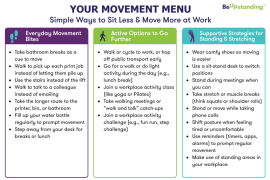
The focus is on small, sustainable changes, such as standing meetings, stretch breaks, or redesigning office workflows, that encourage sitting less and moving more throughout the workday.

Final Thoughts
Public servants are a largely untapped group in workplace movement research, including in Australia. Yet their work context offers rich opportunities for understanding how sitting less and moving more can be implemented in structured, demanding environments.
With evidence clearly supporting the benefits of movement, both for reducing pain and enhancing workplace wellbeing, perhaps it’s time we looked more closely at the people who serve the public and ask: How can we better support them to sit less and move more?
After all, if they can do it, what’s stopping the rest of us?
This blog was written by Alastair Tiong






Comments are closed.