We know that spending long periods sitting is associated with poorer health. But what is actually happening in our muscles while we sit?
New research has taken a closer look at muscle activity during everyday sitting. The findings suggest that muscle activity becomes progressively lower the longer we remain seated, adding to the evidence that breaking up prolonged sitting with regular movement is likely to be beneficial.

Looking beyond whether we are simply sitting or moving
Much of what we know about sedentary behaviour comes from devices such as accelerometers, which can tell us when someone is sitting, standing or moving – particularly when worn on the thigh.
These measures have been important in understanding the health impacts of prolonged sitting, but they tell us less about what our muscles are doing while we are seated.
A new study published in npj Exercise Medicine and Health, led by researchers in Finland and including BeUpstanding’s Professor Genevieve Healy, examined this in more detail.
Participants wore specialised shorts containing fabric-based electromyography (EMG) sensors. EMG measures the electrical activity produced when muscles contract, allowing the researchers to detect relatively small changes in thigh-muscle activity during everyday life.
Across three studies, the researchers examined 7,684 periods of sitting from 84 adults going about their normal daily activities.

Image: https://www.mindtecstore.com/Myontec-MBody-3-Fitness-Set
What happens to muscle activity during sitting?
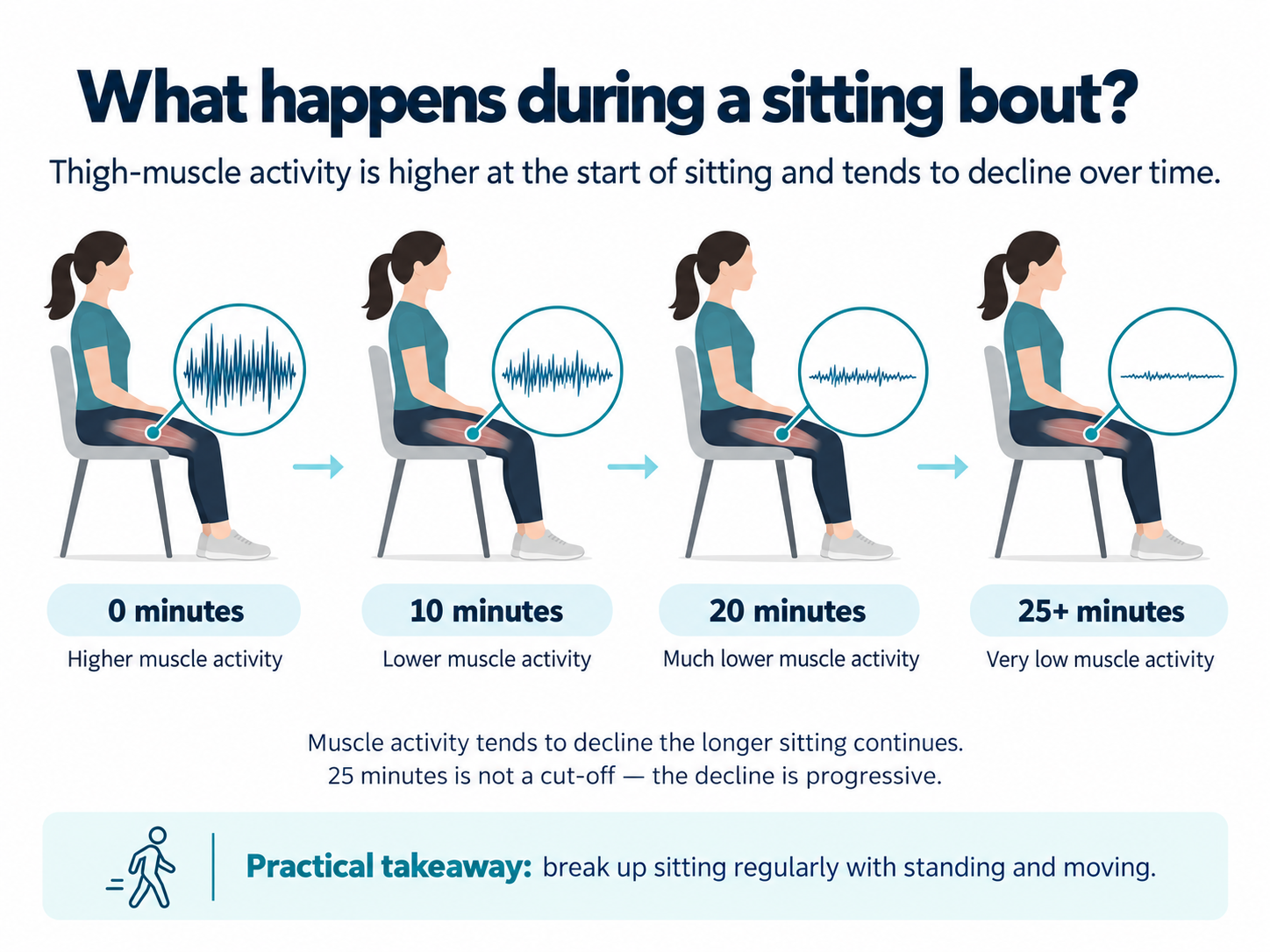
As might be expected, the researchers found that muscle activity became progressively lower the longer people remained seated.
Muscle activity was relatively higher at the beginning of a sitting period and declined as sitting continued. Based on their modelling, detectable muscle activity became increasingly uncommon as sitting approached around 25 minutes.
People who tended to accumulate their sitting in longer periods also showed less muscle activity while sitting than those whose sitting was generally broken up more frequently.
Importantly, this does not mean that 25 minutes is a specific threshold at which sitting suddenly becomes harmful. Rather, it suggests that muscle activity progressively declines across a period of uninterrupted sitting.
The practical message is therefore less about watching the clock, and more about avoiding long periods of sitting without changing posture or moving.
What happens before we sit may also matter
One of the more interesting findings was that muscle activity during sitting appeared to be influenced by what people had been doing beforehand.
When sitting was preceded by longer or more intense physical activity, muscle activity remained higher for longer after people sat down.
Similarly, people who interrupted their sitting more frequently, and with more substantial movement, accumulated more detectable muscle activity overall.
The researchers estimated that more frequent and higher-intensity interruptions could result in around five additional minutes of muscle activity for every hour spent sitting.
This suggests that the benefits of getting up and moving may not be limited to the period of movement itself. Activity before sitting may also influence how active our muscles remain once we sit down again.

Why might this matter?
Skeletal muscle has an important role in processes such as glucose regulation and circulation. When our large muscles remain relatively inactive for long periods, some of these processes may also be reduced. This is one of the mechanisms that may help explain the associations we see between prolonged sedentary behaviour and poorer cardiometabolic health.
This study did not test whether sitting for a particular length of time directly causes chronic disease. Rather, it helps us better understand one of the possible physiological pathways through which prolonged sitting may affect health.
It also reinforces an important point: when thinking about sedentary behaviour: how sitting is accumulated may matter as well as how much sitting we do overall.
What does this mean for the workday?
For most people, sitting is a normal and necessary part of work. The aim is not to remove sitting, but to find practical ways to avoid long, uninterrupted periods of it.
This might include:
– standing or walking between tasks
– getting up to refill a water bottle
– walking to speak with a colleague
– standing or moving during suitable phone calls
– taking a longer route to the kitchen or bathroom
– having a walking meeting where appropriate
– taking lunch away from the desk
– standing, stretching or walking between meetings.
These are simple strategies, but when they occur regularly across the day they can help create a more varied pattern of sitting, standing and moving. Programs like BeUpstanding help to make these changes part of the culture of work.
Think regular movement rather than a perfect number
There is often a desire for research to provide a single number for how long is “too long” to sit.
This study provides useful insight, but it does not establish a new 25-minute sitting recommendation. Instead, it shows that muscle activity becomes progressively lower the longer sitting continues, and that activity before and between sitting periods may help keep muscles more active.
The more useful question may therefore be: how often are there opportunities to change posture and move across the workday?
Building small amounts of movement into everyday work remains a practical way to reduce prolonged sitting and create a more active workday.
Stand Up. Sit Less. Move More.
Reference: Brakenridge , C.J., Lamberg, S., Rantalainen, T. et al. When we sit: textile electromyography identifies decreasing muscle activity and implications for metabolic health. npj Exerc. Med. Health 1, 7 (2026). https://doi.org/10.1038/s44437-026-00002-5