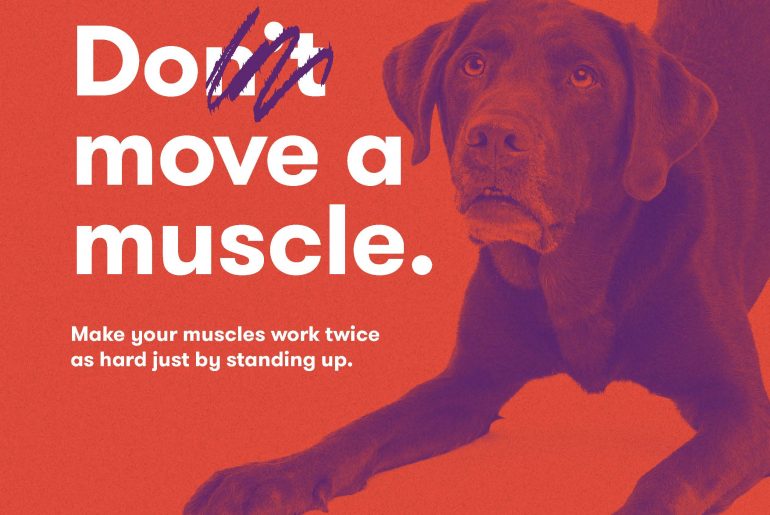
It is hard to imagine too many situations in the office where you would need to freeze and not move a muscle. Hence – our week 4 poster invites BeUpstanding participants to “do move a muscle”, and to do so regularly throughout the day. But what are the benefits of doing this? When we are seated, our large postural muscles in our legs do not have to work very hard. However, just by standing up, muscle activation can increase substantially. For example, one study in 84 middle aged volunteers from Finland were asked to wear special shorts that measured the electromyographic (EMG) or muscle activity of their quadriceps and hamstrings. They were asked to do a number of activities (lying down, standing, sitting, squatting, stair climbing, walking, running) as well as a maximal isometric voluntary contraction (MVC) – a standard test for measuring muscle strength. The EMG activity of each of the tasks was then compared to what the participant achieved during the MVC. When sitting, participants thigh muscles were only activated at about 1% of their maximum. This increased to 2.5% just by standing, about 10-12% by walking, and a substantial 22-25% by squatting or climbing up stairs. In…
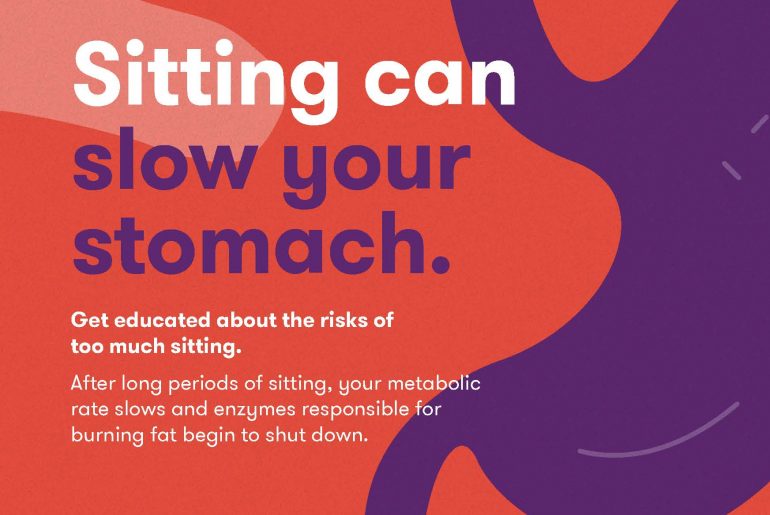
Sitting can slow your stomach – Part 1
Have you ever experienced stomach pains, discomfort, or indigestion after sitting too long at your desk? While exercise has long been anecdotally thought to influence digestion, more recent research has been exploring the impact of physical inactivity on digestion. This post will explore some ways exercise and inactivity influences your gut, as well as the implications for your health. But first, what does it mean to say that sitting “slows your stomach?” One way to consider it would be gastric emptying, or the movement of stomach contents into the small intestine (how quickly food leaves the stomach). Another possibility is gastrointestinal transit time, which is the time it takes something you eat to move from your mouth through your entire gastrointestinal tract. Both these definitions have been linked to physical activity and inactivity, as have health outcomes such as constipation and colorectal cancer. How physical inactivity slows your stomach: When you aren’t moving, your gut isn’t moving much either. An extreme example can be seen in people who are confined to bed or held immobile. Hospital inpatients are another population at risk of prolonged physical inactivity, and increased rates of constipation are seen in this population. However it can be…
How Can Using a Standing Desk Affect Your Productivity
This article is re-posted from a Sedentary Behaviour Research Network blog post on 3rd July 2019. Recently, research into the topic of excessive sitting, or “sedentary behaviour”, has been making headlines. The risk for chronic diseases, such as diabetes and obesity, that comes with high levels of sitting is becoming more evident (1). Office workers represent a population that spend a significant amount of time in sedentary pursuits as a consequence of their occupation (2). As more research is being published on the topic, many workplaces are seeking non-sedentary alternatives and solutions to the traditional office environment to keep their employees as healthy and productive as possible. One such solution has been the implementation of activity-permissive workstations. Activity-permissive, or alternative, workstations replace a worker’s traditional desk and are broadly categorized into either standing desks or dynamic workstations. Standing desks allow for a worker to stand while performing a task (e.g., typing, clerical work), and can be installed as additions to an existing workstation, or as height-adjustable replacement units (see Figure 1). Dynamic workstations are designed to allow for activity or movement while working, and include a variety of alternative workstations, such as: treadmill desks, cycling desks, and dynamic sitting desks…
“Sit less—move more and more often”: all physical activity is beneficial for longevity
This article was originally published in the BMJ Opinion on 21st August 2019. New research shows that any level of movement decreases risk of premature death, so get moving say Ulf Ekelund and Thomas Yates It is well established that physical activity of a moderate or vigorous intensity (such as brisk walking) is good for your health. More recently, it has also been shown that people in contemporary societies are spending the majority of their day sitting, and that this prolonged sitting is also linked to an increased risk for many chronic diseases and premature death. Current physical activity recommendations, including those recently updated for the US, suggest that at least 150 minutes per week of moderate intensity physical activity is needed to keep healthy and that prolonged sitting should be avoided. However, how much sitting is too much? This is not specified and is widely debated. In addition, are levels of physical activity below those recommended still beneficial for health and does light intensity physical activity still count? Answering these questions have huge relevance for health promotion. We performed a study to address these questions. Our results suggest strong associations between total physical activity and the risk of dying.…
How Age and Prolonged Sitting Can Effect Spine Stiffness, Postures and Discomfort
Recent research by Gruevski K and Callaghan J, and published in Ergonomics on 19th April 2019, looked at the effect of age and sex on passive spine stiffness, postures and discomfort in response to seated work. They noted that understanding age-specific postures and pain development patterns during sitting exposures are particularly relevant given the ageing working population in industrialised nations. Participants were in their Late 20s to early 30s or early 60’s were asked to sit continuously for 90 min while typing. Their results showed that older adults had higher passive spine stiffness and sat with less flexion during prolonged sitting. Discomfort was higher among older adults and occurred earlier in the simulation compared to younger participants, indicating that interventions, such as walking breaks may need to be implemented earlier during sitting for aged workers. Click here to read the full article
Standing Up To Sedentary Working
The following article was written by Sophie O’Connell and published in Occupational Health and Wellbeing on the 7th June 2019. The modern world and the constant pursuit of technological growth have almost eliminated the need for movement in our daily lives. While commuting we sit in our cars or on the bus; at work we sit at our computers or in meetings; during our leisure time we sit watching TV, playing computer games or socialising with friends. Because of technology advancements we do not even need to leave the comfort of our own homes to socialise, stay in touch with friends and family, to shop, to work or even be entertained on a screen. This means that, on average, Brits spend around 9.5 hours a day spent sitting. Typically, the amount of time spent sedentary each day increases with age. In working-age adults much of this sitting is done at work. Evidence shows that office-based workers spend around 75% of their working day sitting, with a third of sitting time being done for a prolonged period. Many of us are guilty of spending time sitting for extended periods due to work, travel or various social commitments. But with the growing…
Direct Healthcare Costs Of Sedentary Behaviour In The UK
The following press release originally appeared on the BMJ Newsroom and was published on March 23rd 2019. Spending large amounts of time sitting or lounging around during the day is linked to around 70,000 deaths per year in the UK and the NHS spends in excess of £0.7bn per year treating the health consequences, suggests research from Queen’s University Belfast and Ulster University published online in the Journal of Epidemiology & Community Health. A large proportion of the UK population have sedentary jobs and leisure activities, and official physical activity recommendations regarding sedentary behaviour are vague. Previous studies have shown that spending large parts of the day sitting down increases the risk of cardiovascular disease, type 2 diabetes, cancer and death and is a burden on health services. But no estimate of the financial impact that sedentary behaviour has on the NHS has been calculated, so the authors set out to do just that. Figures calculated by other researchers on the impact sedentary behaviour has on the relative risks of five specific health conditions (type 2 diabetes, cardiovascular disease, colon cancer, endometrial cancer and lung cancer) and deaths from all causes were combined with figures on the percentage of adults…
What Makes A Good Champion?
Are you interested in becoming a workplace champion? Maybe you are looking for someone to assume this role in your workplace but you are unsure where to start. You might ask yourself what makes a ‘good’ workplace champion? Previous research suggests that the most effective workplace champions are those who have a genuine passion for health and wellbeing and are enthusiastic about the opportunity to inspire others towards a healthier lifestyle (Healy et al., 2018). They must also be committed to making long-term positive health changes in their workplace and display a good relationship with their peers. It could be someone that has, or is eager to gain, some experience in managing similar projects. Health and safety representatives are often chosen for this position because it coincides with their goals, namely to create a safer, healthier workplace. However, we must also consider the individual’s capacity to adopt this role. Do they have the time and resources to engage fully with the program within the confines of their own job? Or will it fall into their periphery? These are just a few of the things that must be considered before electing a workplace champion. More general personality traits like outgoingness and…
Can sitting less decrease your risk of heart disease?
The following article, written by Gautam Ramesh, Andrea LaCroix, and John Bellettiere, was originally published on February 25, 2019 in The Conversation. You can read the original article here. Too much sitting has long been criticized for contributing to premature mortality, Type 2 diabetes, and a host of other illnesses. In a new study of 5,638 women, we looked at how sedentary behavior was related to future cardiovascular disease (CVD). The results showed that those who were most sedentary had the highest risk for having a future CVD event. We also found that women who most often interrupted their sedentary time to stand up and move had significantly lower risk for CVD than women who sat for long stretches of time without standing up. The results persisted even after accounting for other common factors linked with CVD such as age, overall health, blood pressure and cholesterol. CVD includes heart attacks, strokes, heart failure and other diseases concerning the heart and blood vessels. It is the leading cause of death in the U.S., accounting for 1 in 4 deaths annually. Our findings, along with the research discussed below, provides strong evidence that sitting too much is an important factor to consider for heart…
The Stone Age Brain and How it Affects Our Physical Activity Levels
Our physical activity levels have never been lower – can we look to our Homo sapiens ancestors for answers? We live in a rapidly changing environment with technology defining the modern world we live in. An increase in tasks and jobs automation has led to a vastly different workplace than what we have previously known. Workplaces are now sedentary by nature and require far less energy output as before. The low activity life we have had to adopt is not healthy nor happy. But are there explanations for our ill health in the modern environment which would explain why change is so difficult? Humans have evolved to respond to behaviour triggers like hunger, thirst, and tiredness with behaviours which overcome these desires. These basic instincts worked to keep us alive in the ancestral environment where food, water, and shelter were competitive resources to have and to obtain. By instinctually knowing you were hungry, thirsty or tired, it meant you were able to provide for yourself and keep yourself healthy in harsh environments. These are not instincts we have lost, we still feel hungry, thirsty and tired, and we feel them daily. However, the environment in which we live has changed…