The International Society for Physical Activity and Health (ISPAH) has paired up with WHO to run a series of webinars based on the release of the WHO Guidelines on physical activity and sedentary behaviour. The latest one on the 4th March featured BeUpstanding principal investigator A/Prof Genevieve Healy as part of the line-up, talking about the evidence on how to reduce sedentary behaviour. Check out the video below. You can also catch the other webinars in the series at: https://www.ispah.org/resources/free-webinars/
A new report, funded by Wellcome, explores the potential health risks associated with high levels of occupational sitting and methods to reduce excessive sitting in the workplace or home working environment. Below is a summary of the report, taken from here. A full summary of the report can be found here, while a summary presentation of our key findings can be found here, and a podcast can be found here. BeUpstanding investigators David Dunstan and Genevieve Healy were co-authors on the report, which was led by Aaron Kandola. Full author list: Aaron Kandola, Jessica Rees, Brendon Stubbs, David W Dunstan, Genevieve N Healy, Joseph F Hayes Background Due to the rising prevalence of desk-based work, excessive sitting represents an emerging occupational health and safety issue. Employed adults are typically sitting for over 9 hours per day. Spending large periods of the day seated with insufficient active breaks increases the risk of several physical and mental health conditions, including depression and anxiety disorders. Allowing or facilitating excessive sitting in the workplace can affect employees’ mental health and compromise the duty of care between an employer and employee. Combatting excessive occupational sitting with regular breaks involving light activity for a couple of…
By now we all know that the COVID-19 global pandemic has caused an unprecedented change in how and where people are working. Helping people to sit less and move more at work has been a key priority in recent years, with much of the focus being on the office workplace. The phrases ‘pre-COVID’ and ‘COVID-normal’ are thrown around a fair bit these days, but perhaps they are a fitting way to describe the shift that many desk-based workers have experienced. Even for those who have now returned to their workplaces, the ‘pre-COVID’ work environment is likely to be quite different to the ‘COVID-normal’ workplaces many are now working in. Other workers have seen a complete (perhaps long term) shift to working remotely, or a mix of both. What remains, however, is the need to ensure a safe and healthy workplace for everyone. We do not yet know the long-term impacts of these current changes to our work environment, but we do know that there is a clear need to continue to help workers to be able to sit less and move more, regardless of where they are working. The term ‘desk-based workers’ rather than ‘office workers’ is a term we often…
On September 1st, BeUpstanding celebrated three years of going online. In that time, we have had over 650 workplaces unlock the toolkit, with potentially more than 56,000 staff exposed to the program! We have also published over 100 blogs! Of course, the journey to supporting workers to sit less and move more has been a lot longer than that, spanning over a decade and resulting in a substantial body of evidence into what works. The data collected through BeUpstanding is making an important contribution to this evidence base as it is examining how well the program works when it is delivered in a widely-accessible format and without direct support from researchers. Key questions we are interested in are: who is taking up the program, how are they running the program, how effective is the program, the costs of the program, and the sustainability of any changes. We received funding from the NHMRC Partnership Project scheme to address these questions in the context of a national implementation trial. Teams who sign up to the trial must commit to completing all the evaluation elements in the program, as well as complete an additional evaluation approximately 9 months after program completion to understand…
Dr Ana Goode and A/Prof Genevieve Healy – the lead investigators on BeUpstanding – featured on the latest episode of the Physical Activity Researcher podcast – a Finnish initiative. They discuss the evidence that underpins BeUpstanding, the impact of COVID-19 on the program, and some simple strategies workplaces can do right away to start sitting less and moving more. Enjoy!
This article was posted by the ABC online on the 31st March, 2020. You can find the original article here. Working from home during coronavirus shutdown? These hacks may help keep ease the pain of your home office ABC Health & Wellbeing – By Genelle Weule Working from home can be physically and psychologically challenging. (Getty Images: Planet Flem) Kitchen benchtops and dining room tables around Australia have become workspaces as office workers have been advised to work from home in the face of the coronavirus pandemic. Where the opportunity to work from home in your PJs might have once seemed like a treat, the rapid shift to working from home — if that is even an option for you — is challenging. Suddenly, you may find yourself working in the same space as your family, bent over a laptop instead of sitting or standing at a dedicated workstation with ergonomic equipment. The combination of long hours on a laptop on the kitchen table can be both physically and psychologically stressful over the long haul. “It’s worth investing some time thinking about how to make this work to protect your physical and mental wellbeing,” said Jodi Oakman, who leads the Centre for Ergonomics and Human…
I was perusing the British movement blog Get Britain Standing when I came across their solutions page. Get Britain Standing is a resource for employers much like Australia’s BeUpstanding, which focuses on a healthier Britain by reducing the prolonged hours of sitting that accompany many jobs. Their upcoming nationwide event On Your Feet Britain is set for April 24th 2020 with a reported ~2 million office workers participating. Get Britain Standing accounts that Briton’s working hours contribute ~70% of the daily sedentary health burden. Dr. Stuart Biddle, a professor of Active Living and Public Health is quoted on their website acknowledging the growing body of evidence that to be healthy we must move dynamically throughout the day. Which leads me to what excited me about their Solutions page: the balance board section! The benefit being, as long as you don’t fall off, strengthening your balance and your core muscles at your standing desk. They come in a variety of styles from the simple sea-saw, the log roll, and even the expert level half dome or as I like to call it the danger dome! (see image) Maybe don’t tell HR about the nickname when you bring one to the office.…
This month is Safe Work Month and the theme is Be a Safety Champion. Comcare hosted a series of regional events to mark Safe Work Month, with BeUpstanding featuring as an exemplar of a program that uses a train-the-champion model. You can download and view the presentations from here. One of the key things to help you be a safety champion is good work design. It is important to consider health and safety issues when designing work as this can help to eliminate hazards and manage risks. Effective design of good work considers: the work work systems the physical working environment the workers. Taking into account these things can help improve performance, job satisfaction and productivity. Take a look the Handbook – Principles of Good Work Design* to learn about the ten principles to good work design. Hierarchy of control The hierarchy of control can help identify ways to eliminate or minimise risks to health and safety. The most effective control is to eliminate the risk. However, if that is not possible, working through the hierarchy helps to find the most effective measure. For sitting less and moving more at work, substitution and redesign strategies could include provide high table options in meeting rooms…
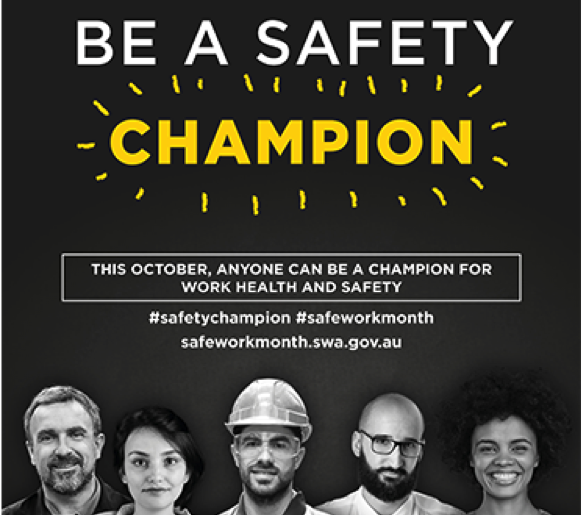
October is National Safe Work Month – a time for workplaces to consider how they can build a safe and healthy workplace for all Australians. This year, Safe Work Australia’s theme for Safe Work Month is ‘Be a Safety Champion’. This is meant to encourage employers and workers from all occupations and industries to become a champion for work health and safety. Everyone can support a safety culture at their workplace and promote best practice work health and safety initiatives. SafeWork Australia’s website has a great list of what’s on in your state or territory. BeUpstanding is a featured resource being promoted for National Safe Work Month! SafeWork Australia has been a long- time supporter of BeUpstanding and is one of five partners in our recent NHMRC parternship grant. This grant has given us funding for a national implementation trial of the BeUpstanding Champion Toolkit. As part of the implementation trial we are able to offer champions free coaching by our expert team and customised data feedback reports. It really is a great time to Be Upstanding!
This October is National Safe Work Month, an initiative of Safe Work Australia. Safe Work Month focuses on asking workers and employers across Australia to commit to building safe and healthy workplaces for all Australians. To launch Safe Work Month, Workplace Health and Safety Queensland are hosting a free breakfast on Wednesday 2 October 2019 at King George Square, Ann St, Brisbane from 7am to 9:30am. There will be free food, lucky draw prizes and giveways, cooking demonstrations and more. The BeUpstanding team will also be there to talk to you about how your workplace can sit less and move more and you can even sign up to be a BeUpstanding Champion on the day. We hope to see you there!